Buy digi4equality.eu ?
We are moving the project
digi4equality.eu .
Are you interested in purchasing the domain
digi4equality.eu ?
domain@kv-gmbh.de · 0541-91531010
Buy digi4equality.eu ?
Do I need DIMM or UDIMM?
The choice between DIMM (Dual In-line Memory Module) and UDIMM (Unbuffered DIMM) depends on the specific requirements of your computer system. DIMM modules are typically used in servers and workstations, while UDIMM modules are more commonly found in desktop computers. If you are building a high-performance system or a server, you may need DIMM modules for their additional features such as error correction and buffering. However, for most consumer desktops and gaming PCs, UDIMM modules are sufficient and more cost-effective. It's important to check your motherboard's specifications to determine which type of memory module is compatible with your system. **
Is UDIMM RAM compatible with DIMM RAM?
Yes, UDIMM (Unbuffered DIMM) RAM is compatible with DIMM (Dual In-line Memory Module) RAM. Both UDIMM and DIMM are types of memory modules used in desktop computers, and they are designed to be compatible with each other. However, it is important to note that when installing UDIMM and DIMM RAM together, they will operate at the speed and timings of the slowest module. **


Similar search terms for Udimm
Top-Angebote
Products related to Udimm:
-
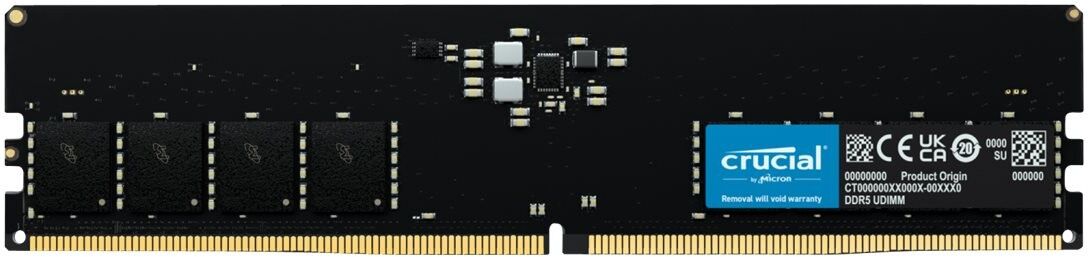
Crucial DDR5-5600 CL46 UDIMM Desktop Memory 8GBCrucial CT8G56C46U5 is an 8GB DDR5 desktop memory module (one 8GB stick). It runs at 5600 MT/s (PC5-44800) with CL46 latency at 1.1V, in the 288-pin UDIMM form factor used by DDR5 desktop PCs. Unbuffered, with on-die ECC and on-module power management (PMIC). On systems limited to 5200 or 4800 MT/s the module runs at the lower supported speed. Check your motherboard supports DDR5 UDIMMs before ordering; DDR5 is not compatible with DDR4 slots. Backed by Crucial's limited lifetime warranty.190,49 £*Shipping: 0,00 £Secure redirect to the provider
-
Crucial DDR5-5600 CL46 UDIMM Desktop Memory 16GBCrucial CT16G56C46U5 is a 16GB DDR5 desktop memory module (one 16GB stick). It runs at 5600 MT/s (PC5-44800) with CL46 latency at 1.1V, in the 288-pin UDIMM form factor used by DDR5 desktop PCs. Unbuffered, with on-die ECC and on-module power management (PMIC). On systems limited to 5200 or 4800 MT/s the module runs at the lower supported speed. Check your motherboard supports DDR5 UDIMMs before ordering; DDR5 is not compatible with DDR4 slots. Backed by Crucial's limited lifetime warranty.321,99 £*Shipping: 0,00 £Secure redirect to the provider
-
Crucial DDR5-5600 CL46 UDIMM Desktop Memory 32GBCrucial CT32G56C46U5 is a 32GB DDR5 desktop memory module (one 32GB stick). It runs at 5600 MT/s (PC5-44800) with CL46 latency at 1.1V, in the 288-pin UDIMM form factor used by DDR5 desktop PCs. Unbuffered, with on-die ECC and on-module power management (PMIC). On systems limited to 5200 or 4800 MT/s the module runs at the lower supported speed. Check your motherboard supports DDR5 UDIMMs before ordering; DDR5 is not compatible with DDR4 slots. Backed by Crucial's limited lifetime warranty.610,99 £*Shipping: 0,00 £Secure redirect to the provider



-
What is the difference between UDIMM and DIMM?
UDIMM (Unbuffered DIMM) and DIMM (Dual In-Line Memory Module) are both types of memory modules used in computers. The main difference between the two is that UDIMM modules are unbuffered, meaning they do not have an additional buffer chip to help with data transfer. DIMM modules, on the other hand, can be either unbuffered or registered, with the registered DIMMs having an additional register to help with data transfer. UDIMMs are typically used in consumer-grade computers, while DIMMs are used in servers and workstations where higher performance and reliability are required. **
-
What is the difference between RDIMM and UDIMM in DDR4?
The main difference between RDIMM (Registered DIMM) and UDIMM (Unbuffered DIMM) in DDR4 memory is that RDIMM includes a register or buffer to help improve signal integrity and reduce electrical load on the memory controller, allowing for larger capacities and better reliability. This makes RDIMM more suitable for servers and workstations that require higher memory capacities and better error correction. On the other hand, UDIMM does not include a register, making it more cost-effective and suitable for consumer-grade desktops and laptops with lower memory requirements. **
-
What is the difference between UDIMM RAM and DIMM RAM?
The main difference between UDIMM (Unbuffered DIMM) RAM and DIMM (Dual In-line Memory Module) RAM is that UDIMM RAM does not have a register or buffer chip, while DIMM RAM does. This means that UDIMM RAM has slightly lower latency and is generally less expensive, but it also has a lower maximum capacity and is less suitable for high-performance applications. DIMM RAM, on the other hand, has a higher maximum capacity and is better suited for servers and workstations that require high memory bandwidth and reliability. **
-
What is Digital Technology 2?
Digital Technology 2 is a course that builds upon the foundational concepts introduced in Digital Technology 1. It delves deeper into topics such as programming, web development, data analysis, and cybersecurity. Students will further develop their skills in using digital tools and technologies to solve real-world problems and gain a more advanced understanding of how technology impacts society. The course aims to prepare students for a career in the rapidly evolving field of digital technology. **


Is the truth table correct in digital technology?
Yes, truth tables are an essential tool in digital technology as they provide a systematic way to represent the relationship between inputs and outputs of logical gates. By using truth tables, engineers can analyze and design complex digital circuits accurately. The truth table ensures that the logic gates operate correctly based on the defined input-output relationships, making it a crucial component in digital technology. **
Is the truth table in digital technology correct?
Yes, truth tables in digital technology are correct and reliable tools for analyzing the behavior of logic gates and circuits. They provide a systematic way to determine the output of a logic gate based on all possible input combinations. By using truth tables, engineers can ensure the accuracy and predictability of digital systems, making them an essential component in the design and verification process. **
Top-Angebote
Products related to Udimm:
-
Crucial DDR4 3200MHz CL22 UDIMM Desktop Memory - 32GBCrucial CT32G4DFD832A is a single 32GB DDR4-3200 UDIMM (CL22, 1.2V, non-ECC, unbuffered) for desktop PCs. It is compatible with DDR4 desktop platforms and falls back to 2933MHz or 2666MHz where the system requires. Backed by Crucial's limited lifetime warranty.386,49 £*Shipping: 0,00 £Secure redirect to the provider
-
Crucial DDR4 3200MHz CL22 UDIMM Desktop Memory - 16GBCrucial CT16G4DFRA32A is a single 16GB DDR4-3200 UDIMM (CL22, 1.2V, non-ECC, unbuffered) for desktop PCs. It is compatible with DDR4 desktop platforms and falls back to 2933MHz or 2666MHz where the system requires. Backed by Crucial's limited lifetime warranty.257,99 £*Shipping: 0,00 £Secure redirect to the provider
-
Crucial DDR5-5600 CL46 UDIMM Desktop Memory 8GBCrucial CT8G56C46U5 is an 8GB DDR5 desktop memory module (one 8GB stick). It runs at 5600 MT/s (PC5-44800) with CL46 latency at 1.1V, in the 288-pin UDIMM form factor used by DDR5 desktop PCs. Unbuffered, with on-die ECC and on-module power management (PMIC). On systems limited to 5200 or 4800 MT/s the module runs at the lower supported speed. Check your motherboard supports DDR5 UDIMMs before ordering; DDR5 is not compatible with DDR4 slots. Backed by Crucial's limited lifetime warranty.190,49 £*Shipping: 0,00 £Secure redirect to the provider
-
Crucial DDR5-5600 CL46 UDIMM Desktop Memory 16GBCrucial CT16G56C46U5 is a 16GB DDR5 desktop memory module (one 16GB stick). It runs at 5600 MT/s (PC5-44800) with CL46 latency at 1.1V, in the 288-pin UDIMM form factor used by DDR5 desktop PCs. Unbuffered, with on-die ECC and on-module power management (PMIC). On systems limited to 5200 or 4800 MT/s the module runs at the lower supported speed. Check your motherboard supports DDR5 UDIMMs before ordering; DDR5 is not compatible with DDR4 slots. Backed by Crucial's limited lifetime warranty.321,99 £*Shipping: 0,00 £Secure redirect to the provider
-
Do I need DIMM or UDIMM?
The choice between DIMM (Dual In-line Memory Module) and UDIMM (Unbuffered DIMM) depends on the specific requirements of your computer system. DIMM modules are typically used in servers and workstations, while UDIMM modules are more commonly found in desktop computers. If you are building a high-performance system or a server, you may need DIMM modules for their additional features such as error correction and buffering. However, for most consumer desktops and gaming PCs, UDIMM modules are sufficient and more cost-effective. It's important to check your motherboard's specifications to determine which type of memory module is compatible with your system. **
-
Is UDIMM RAM compatible with DIMM RAM?
Yes, UDIMM (Unbuffered DIMM) RAM is compatible with DIMM (Dual In-line Memory Module) RAM. Both UDIMM and DIMM are types of memory modules used in desktop computers, and they are designed to be compatible with each other. However, it is important to note that when installing UDIMM and DIMM RAM together, they will operate at the speed and timings of the slowest module. **
-
What is the difference between UDIMM and DIMM?
UDIMM (Unbuffered DIMM) and DIMM (Dual In-Line Memory Module) are both types of memory modules used in computers. The main difference between the two is that UDIMM modules are unbuffered, meaning they do not have an additional buffer chip to help with data transfer. DIMM modules, on the other hand, can be either unbuffered or registered, with the registered DIMMs having an additional register to help with data transfer. UDIMMs are typically used in consumer-grade computers, while DIMMs are used in servers and workstations where higher performance and reliability are required. **
-
What is the difference between RDIMM and UDIMM in DDR4?
The main difference between RDIMM (Registered DIMM) and UDIMM (Unbuffered DIMM) in DDR4 memory is that RDIMM includes a register or buffer to help improve signal integrity and reduce electrical load on the memory controller, allowing for larger capacities and better reliability. This makes RDIMM more suitable for servers and workstations that require higher memory capacities and better error correction. On the other hand, UDIMM does not include a register, making it more cost-effective and suitable for consumer-grade desktops and laptops with lower memory requirements. **
Similar search terms for Udimm
-
Crucial DDR5-5600 CL46 UDIMM Desktop Memory 32GBCrucial CT32G56C46U5 is a 32GB DDR5 desktop memory module (one 32GB stick). It runs at 5600 MT/s (PC5-44800) with CL46 latency at 1.1V, in the 288-pin UDIMM form factor used by DDR5 desktop PCs. Unbuffered, with on-die ECC and on-module power management (PMIC). On systems limited to 5200 or 4800 MT/s the module runs at the lower supported speed. Check your motherboard supports DDR5 UDIMMs before ordering; DDR5 is not compatible with DDR4 slots. Backed by Crucial's limited lifetime warranty.610,99 £*Shipping: 0,00 £Secure redirect to the provider
-
Silicon Power DDR4 2400MHz CL17 UDIMM Desktop Memory Module 4GBSilicon Power 4GB DDR4 desktop memory module (part number SP004GBLFU240X02). A single 288-pin unbuffered, non-ECC DDR4 UDIMM running at 2400MHz (PC4-19200) with CL17 latency (timings 17-17-17-39) at 1.2V. Fit it on its own as a 4GB upgrade, or install modules in matched pairs for dual-channel operation in a DDR4 desktop PC. Check your motherboard's supported memory list before buying. Silicon Power tests its DDR4 modules before shipping, and this module is covered by Silicon Power's lifetime warranty.64,99 £*Shipping: 0,00 £Secure redirect to the provider
-
Silicon Power DDR4 2400MHz CL17 UDIMM Desktop Memory Module 16GBSilicon Power 16GB DDR4 desktop memory module (part number SP016GBLFU240X02). A single 288-pin unbuffered, non-ECC DDR4 UDIMM running at 2400MHz (PC4-19200) with CL17 latency (timings 17-17-17-39) at 1.2V. Fit it on its own as a 16GB upgrade, or install modules in matched pairs for dual-channel operation in a DDR4 desktop PC. Check your motherboard's supported memory list before buying. Silicon Power tests its DDR4 modules before shipping, and this module is covered by Silicon Power's lifetime warranty.119,99 £*Shipping: 0,00 £Secure redirect to the provider
-
What is the difference between UDIMM RAM and DIMM RAM?
The main difference between UDIMM (Unbuffered DIMM) RAM and DIMM (Dual In-line Memory Module) RAM is that UDIMM RAM does not have a register or buffer chip, while DIMM RAM does. This means that UDIMM RAM has slightly lower latency and is generally less expensive, but it also has a lower maximum capacity and is less suitable for high-performance applications. DIMM RAM, on the other hand, has a higher maximum capacity and is better suited for servers and workstations that require high memory bandwidth and reliability. **
-
What is Digital Technology 2?
Digital Technology 2 is a course that builds upon the foundational concepts introduced in Digital Technology 1. It delves deeper into topics such as programming, web development, data analysis, and cybersecurity. Students will further develop their skills in using digital tools and technologies to solve real-world problems and gain a more advanced understanding of how technology impacts society. The course aims to prepare students for a career in the rapidly evolving field of digital technology. **
-
Is the truth table correct in digital technology?
Yes, truth tables are an essential tool in digital technology as they provide a systematic way to represent the relationship between inputs and outputs of logical gates. By using truth tables, engineers can analyze and design complex digital circuits accurately. The truth table ensures that the logic gates operate correctly based on the defined input-output relationships, making it a crucial component in digital technology. **
-
Is the truth table in digital technology correct?
Yes, truth tables in digital technology are correct and reliable tools for analyzing the behavior of logic gates and circuits. They provide a systematic way to determine the output of a logic gate based on all possible input combinations. By using truth tables, engineers can ensure the accuracy and predictability of digital systems, making them an essential component in the design and verification process. **
* All prices are inclusive of VAT and, if applicable, plus shipping costs. The offer information is based on the details provided by the respective shop and is updated through automated processes. Real-time updates do not occur, so deviations can occur in individual cases. ** Note: Parts of this content were created by AI.